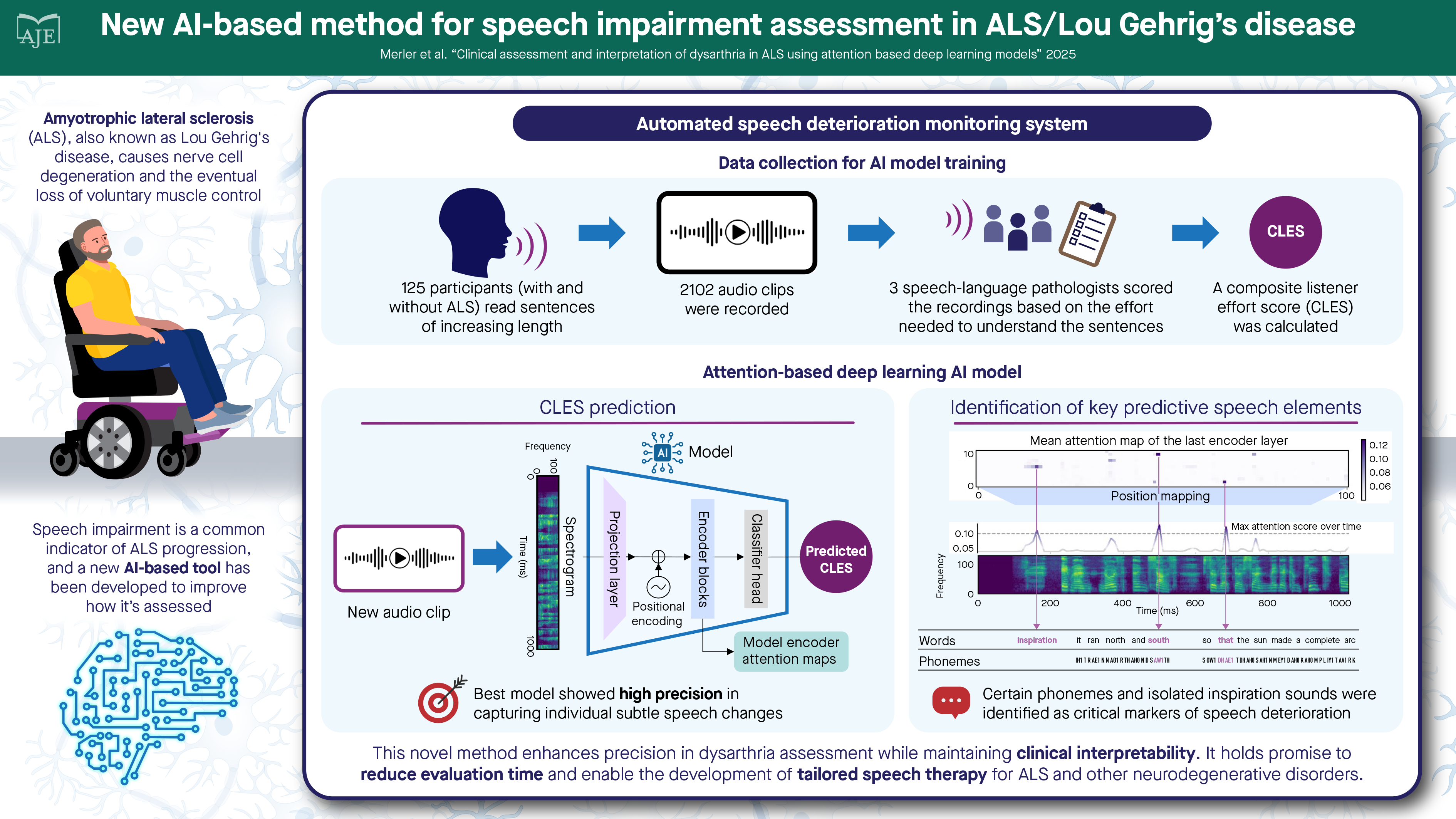
Amyotrophic lateral sclerosis (ALS) is a neurodegenerative motor neuron disease that can cause progressive bulbar dysfunction and dysarthria, resulting in reduced quality of life. Quantitative motor speech analysis can identify features of dysarthria that worsen with ALS progression but are not, inherently, clinically meaningful. Listener effort (LE) is a clinician-rated feature describing how much effort the listener needs to exert to understand the dysarthric speaker. This study investigated whether LE could act as a clinically meaningful measure of ALS dysarthria that could be used as an outcome measure in clinical trials. The Everything ALS Speech Study obtained longitudinal clinical information and speech recordings from 292 participants. In a subset of 125 participants, we measured speaking rate and three speech–language pathologists (SLPs) with expertise in ALS rated LE. We also built and tested a LE prediction algorithm to predict the SLPs' rating of LE. In addition, all speech recordings and associated clinical data are now being made available to ALS researchers via the Everything ALS portal.
Interpretable attention based AI models for LE assessment. Speech dysarthria is a key symptom of neurological conditions like ALS, yet existing AI models designed to analyze it from audio signal rely on handcrafted features with limited inference performance. Deep learning approaches improve accuracy but lack interpretability. We propose an attention-based deep learning AI model to assess dysarthria severity based on listener effort ratings. Using 2,102 recordings from 125 participants, rated by three speech-language pathologists on a 100-point scale, we trained models directly from recordings collected remotely. Our best model achieved R2 of 0.92 and RMSE of 6.78. Attention-based interpretability identified key phonemes, such as vowel sounds influenced by 'r' (e.g., "car", "more"), and isolated inspiration sounds as markers of speech deterioration. This model enhances precision in dysarthria assessment while maintaining clinical interpretability. By improving sensitivity to subtle speech changes, it offers a valuable tool for research and patient care in ALS and other neurological disorders.
Biomarkers for ALS diagnosis. Biomarkers are fundamental for improving early diagnosis, monitoring treatment response, and deepening our understanding of disease mechanisms. The lack of effective biomarkers is particularly detrimental in diseases like amyotrophic lateral sclerosis (ALS), where delays in diagnosis can span 12-18 months, significantly affecting conditions marked by rapid disability progression and reduced lifespan. In this work, we analyzed recordings from 291 participants, including 135 people with ALS (pALS), who performed nine different speech tasks during each session, totaling 6,276 sessions. These recordings were processed using OpenSMILE to extract acoustic features, which were input into three classifiers. We aimed to discriminate pALS from controls and identify different stages of ALS (bulbar manifest and bulbar pre-manifest). We achieved an Area Under the Curve (AUC) of up to 66% (with a recall rate of 79%) and up to 90% (with a recall rate of 91%) for discriminating pre-manifest and manifest ALS from controls, respectively. This work represents a significant step toward identifying reliable biomarkers for ALS, offering new insights into early detection and a better understanding of disease progression.
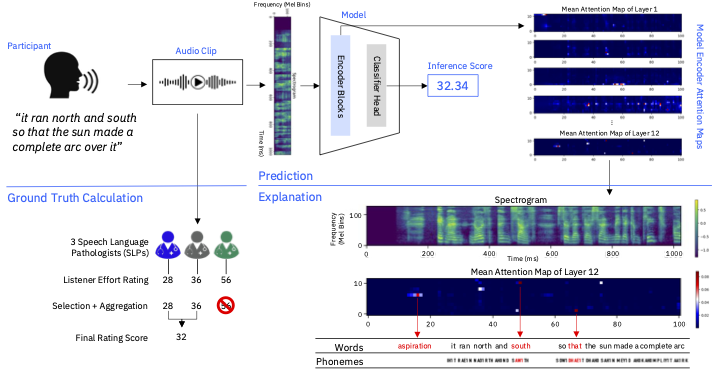
Michele Merler, Carla Agurto, Julian Peller, Esteban Roitberg, Alan Taitz, Marcos A Trevisan, Indu Navar, James D Berry, Ernest Fraenkel, Lyle W Ostrow, Guillermo A Cecchi, Raquel Norel. Clinical assessment and interpretation of dysarthria in ALS using attention based deep learning AI models. npj Digital Medicine (npj DM) 2025. PDF BibTeX
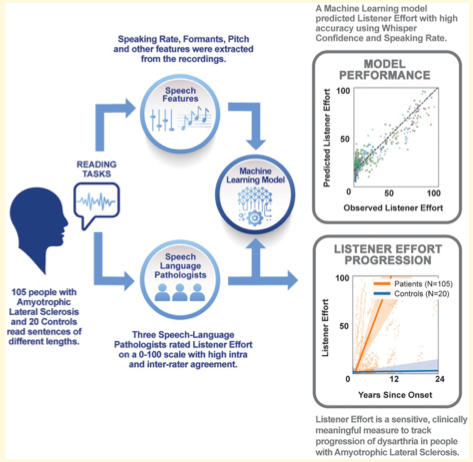
Indu Navar Bingham, Raquel Norel, Esteban G Roitberg, Julián Peller, Marcos A Trevisan, Carla Agurto, Michele Merler, Diego E Shalom, Felipe Aguirre, Iair Embon, Alan Taitz, Donna Harris, Amy Wright, Katie Seaver, Stacey Sullivan, Jordan R Green, Lyle W Ostrow, Ernest Fraenkel, James D Berry. Listener effort measures clinically meaningful change of dysarthria in amyotrophic lateral sclerosis. Brain Communications (BC) 2025. PDF BibTeX
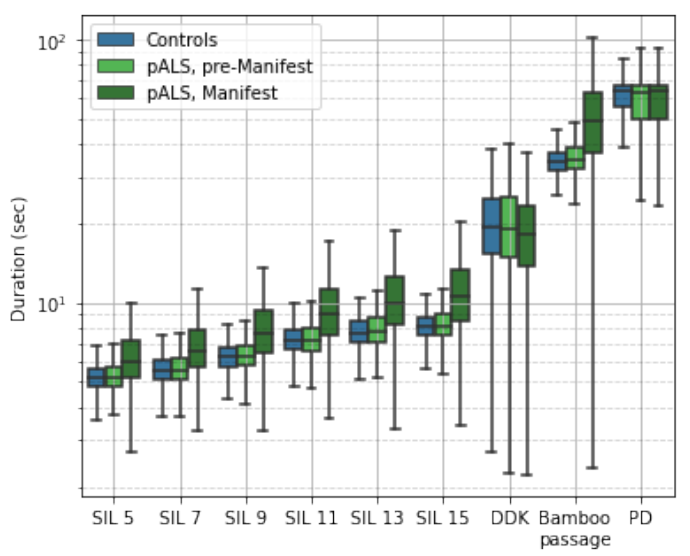
Carla Agurto, Michele Merler, Esteban Roitberg, Alan Taitz, Marcos A. Trevisan, Diego E. Shalom, Julian Peller, Lyle W. Ostrow, Indu Navar, Ernest Fraenkel, James Berry, Guillermo A. Cecchi and Raquel Norel. Harnessing Remote Speech Tasks for Early ALS Biomarker Identification. IEEE International Conference on Digital Health (ICDH) 2024. PDF BibTeX